


 Shkruar nga Gjergj Zefi
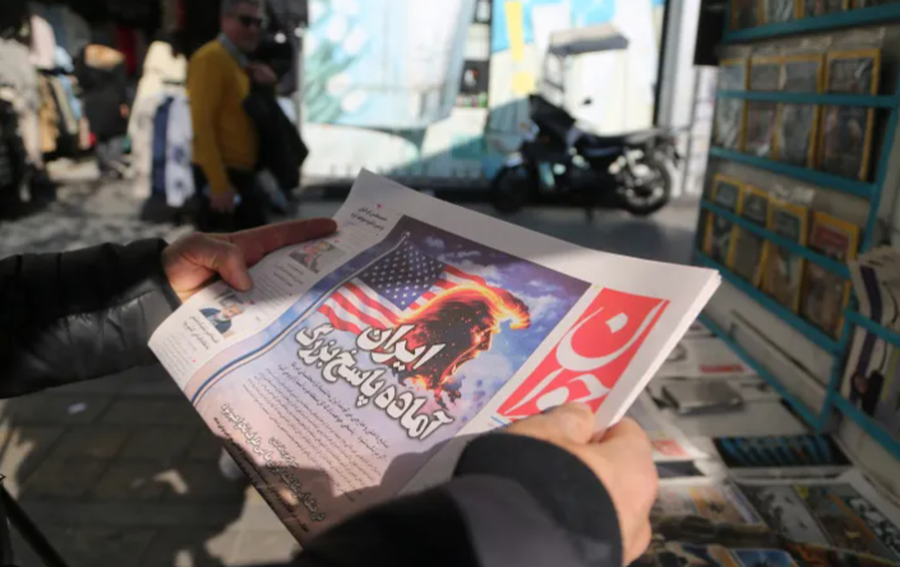
Trump tightens grip on Iran, not the regime: The American president demands strategic concessions from Tehran, while violence against the opposition is not on the agenda...
President Donald Trump, returned to the White House with a promise to make America "strong and respected again," has reopened the most dangerous front in foreign policy: confronting Iran.
Through a statement shared on his social media, Trump warned that an "extraordinary American army" is already moving towards the Persian Gulf. Not to fight, but to impose conditions.
Essentially, this is not a call for war, but an attempt to force Iran to the table. And contrary to what some quarters expected, the demands do not include regime change or military intervention to support the domestic opposition.
On the contrary, President Trump has articulated three clear conditions towards Tehran, which, according to him, are negotiable if Iran acts quickly.
First, the total cessation of the uranium enrichment program for military purposes and international verification of all nuclear facilities.
Second, the gradual withdrawal of Iranian influence from regional conflicts, particularly in Yemen, Syria, and Lebanon, where the Revolutionary Guard has been present through local allies.
And third, the immediate release of American and European prisoners held on political or espionage charges, a topic that has soured relations with the West in recent years.
Beyond these demands, what is striking is the lack of any reference to regime change or the “massacre of opposition forces” in Iran; a line that separates Trump from many neoconservative voices in Washington. He is not trying to overthrow the Iranian regime, but to force Tehran to make strategic concessions without direct confrontation.
It seems like a game of strength and diplomacy at the same time, but the situation is dangerous.
Iran, as expected, has rejected any form of negotiation under pressure. Tehran’s rhetoric has shifted to a defensive military mode, threatening to close the Strait of Hormuz in the event of aggression and to “respond with the full arsenal at its disposal” to any US attack. This is not just a battle over nuclear centrifuges, but a direct confrontation for strategic dominance in the Middle East, where any US move against Iran affects Iraq, Syria, Lebanon, Yemen and beyond.
Tehran warns that any attempt to violate its sovereignty will lead to a harsh response not only on its territory, but throughout its entire axis of influence: from the Gulf of Aden to the border with Israel.
In this context, any blow, even minimal, could be the spark of a conflict involving more than two states. Europe has neither a unified stance nor the means to stop an escalation. Russia and China see this as an opportunity to weaken the American position in the Middle East, while the most exposed countries, including Albania, are in the role of helpless spectators, but nevertheless exposed to the waves of the crisis.
Fuel prices, economic uncertainty, the influence of foreign services and the lack of stability in the region are direct consequences even for a country like ours. Therefore, Albania's foreign policy cannot remain silent. It must clearly articulate its position in Euro-Atlantic alliances and commit itself more to preserving peace through diplomacy, not through blind military alignments.
Trump is putting Iran with its 'shoulders against the wall'. But the question that arises is: will Iran choose to sit at the table, or will it shoot first? / Pamphlet



Lini një Përgjigje