


 Shkruar nga Gjergj Zefi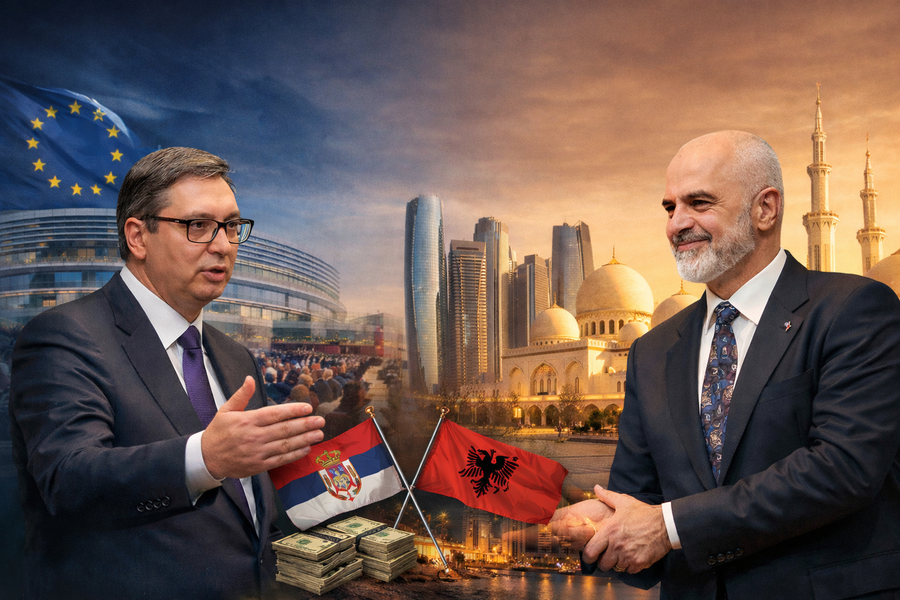
As Vučić clashes with the European Parliament and Rama seeks refuge in capital diplomacy, the Balkans risks confusing investment with strategy and alternatives with illusion...
The recent clash between Belgrade and the European Parliament, articulated publicly through Aleksandar Vučić’s disparaging statements towards the MEP delegation and the rapporteur for Serbia, is not just another rhetorical episode in strained Serbia-EU relations. It represents a culmination of a longer process of political distancing, where Serbian authorities are increasingly treating the European Union as a critical actor rather than a strategic project.
The European Parliament, despite its executive limitations, remains the institution that most clearly articulates concerns about democracy, the rule of law and the geopolitical orientation of candidate countries; for this reason, the symbolic refusal to meet it or its public delegitimization is in itself a rejection of the logic of the integration process.
Against this backdrop, it is no coincidence that Vučić, in parallel with this clash, chooses to be in Abu Dhabi, as does Edi Rama. The presence of two Balkan leaders in the same diplomatic space outside Europe sends a clear political message: the search for alternatives, or at least the perception of alternatives, to Brussels.
The United Arab Emirates has become an attractive platform for regional leaders in recent years, offering investment, quick deals, and economic diplomacy that is free from political conditions, critical reports, or demands for structural reforms. This is where the core of the strategic problem lies.
Proximity to the Emirates, and to a more limited extent dialogue with Saudi Arabia, creates an illusion of geopolitical maneuvering, but not a real alternative. These partners do not offer institutional integration, democratic guarantees or long-term anchoring in a political order that produces stability. They offer capital, influence and bilateral relations, which may be useful in the short term, but do not replace the political and economic architecture offered by the European Union. For Serbia, this approach risks deepening the gradual isolation from the European process, moving the country into a gray area where balancing between the West and other actors becomes an end in itself. For Albania, the risk is more subtle, but no less: the perception of a foreign policy that pursues capital and momentary opportunity, rather than a clear Euro-Atlantic strategic axis.
Essentially, the tension between Serbia and the European Parliament and the parallel intensification of Balkan diplomacy towards the Gulf are not separate developments. They are two sides of the same trend: fatigue from European conditionality and the temptation to relativize it through partners who do not demand reforms, but offer agreements. The problem is that this strategy, however politically understandable in the short term, is wrong in the long term. It weakens the European credibility of the countries of the region, pushes the Balkans towards a pluralism of alliances without an axis of values, and leaves societies hostage to centralized decision-making, far from democratic control.
In a diplomatic but realistic reading, the Emirates and Saudi Arabia may be useful economic partners, but not strategic pillars. The European Union, with all its crises and slowness, remains the only project that offers institutional transformation and long-term stability for the Balkans. Any attempt to replace this reality with the illusion of quick alternatives risks deepening the region's strategic ambiguity and producing more dependence, and less sovereignty./ Pamphlet





Lini një Përgjigje