


 Shkruar nga Gjergj Zefi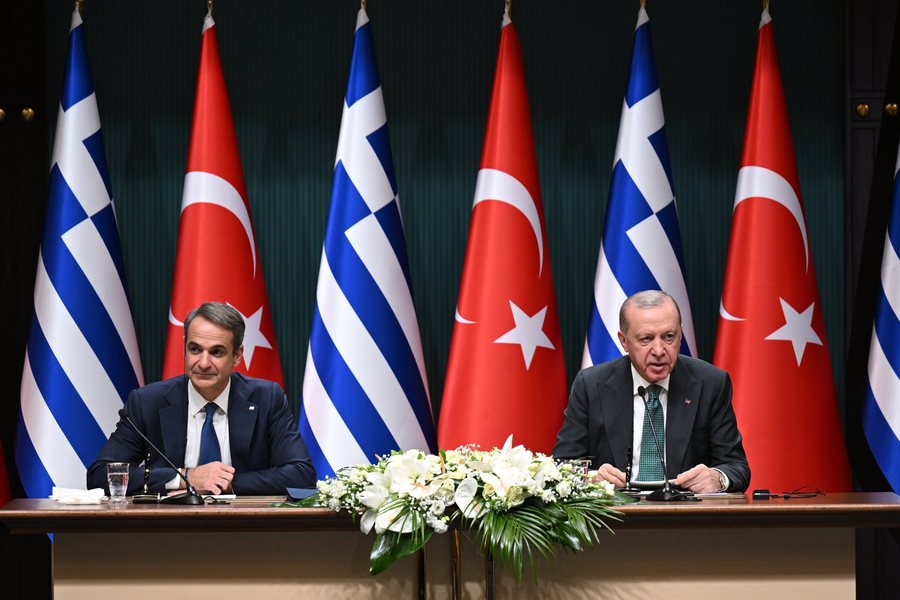
Aegean as a precedent: How could the Turkey-Greece clash affect the fate of the maritime agreement between Tirana and Athens?!
Recep Tayyip Erdogan appeared before the media today in Ankara, with a sentence that sounds like diplomatic balm: the issues with Greece are "complicated, but not insoluble."
At his side, Kyriakos Mitsotakis maintained the measured tone of a leader who knows that every sentence on the Aegean carries the weight of a military maneuver. On paper, everything looks like a new chapter in the dialogue between Turkey and Greece. On the ground, however, the game is much deeper and much more strategic.
Because the Aegean is not just a maritime space; it is a geopolitical node where NATO interests, the energy ambitions of the Eastern Mediterranean and the European security architecture intersect. Every phrase about “dialogue” translates into calculations about airspace, territorial waters, exclusive economic zones. Ankara demands a review of balances that it considers historically unjust; Athens defends the status quo as a guarantee of sovereignty. In the midst of this silent clash, the word “international law” is used by both sides, but with diametrically opposed readings.
On the surface, the rhetoric has softened. After years of tensions, provocative flights, and harsh statements, we have a calmer climate. But this calm is more of a tactical truce than a strategic reconciliation.
Turkey needs stability on its western flank while managing open files in the Middle East and the Black Sea.
Greece, on the other hand, seeks to capitalize on European support and consolidate its position as a pillar of security in the Eastern Mediterranean.
Both sides know that direct confrontation would be a dangerous luxury at a time when the global security architecture is faltering.
But is this a spirit of compromise or simply a reformatting of tactics?
Turkey has made it clear that it will not give up its claims for a more “fair” division of maritime spaces and energy resources. Greece considers any concession a dangerous precedent. Essentially, we have two national narratives clashing: one that speaks of historical correction, the other of protecting sovereignty guaranteed by international treaties.
The energy dimension adds to the tension. The Eastern Mediterranean is no longer just a map of islands and maritime borders; it is a huge natural gas potential, an alternative corridor for Europe seeking to reduce its dependence on uncertain sources. In this context, every nautical mile translates into billions of euros and political influence. Here lies the essence of the silent conflict: not flags on islands, but pipelines under the sea.
In this picture, NATO plays the role of cautious mediator. Two members of the alliance cannot openly confront each other without undermining its cohesion. But the alliance is not a legal arbiter; it is a security structure. This means that the real solution must come from bilateral negotiations or an international judicial process; options that require political courage and domestic consensus, two elements that are often lacking in Athens and Ankara.
For Albania and the region, developments between Turkey and Greece are not simply a diplomatic chronicle. Any change in the balance in the Aegean is reflected in the Mediterranean, the Balkans, and in energy projects that directly affect our strategic interests.
For Albania, this dynamic is not a distant diplomatic development, but a direct reflection of our dilemmas with Athens, especially in relation to the maritime agreement and its referral to the International Court of Justice. Any precedent created in the Aegean for the delimitation of maritime spaces, any new interpretation of international law or political pressure on sovereignty, may indirectly affect Tirana's negotiating position. In this sense, the silent Turkey-Greece clash is also a strategic lesson for Albania: in maritime matters, emotions cost, while legal details decide the fate of generations.
Stability between the region's two powerful neighbors is a guarantee of a calmer geopolitical space; tension, on the contrary, creates a vacuum that other global actors quickly fill.
Erdoğan says that the problems are not insoluble. It is a statement that sounds like an offer, but also like a warning: if a compromise is not found, the dynamics of the terrain could impose new realities. Mitsotakis talks about dialogue, but he knows that every step must pass the filter of Greek public opinion and European partners. In the end, diplomacy between Turkey and Greece is a difficult chess game, where every move has echoes far beyond the shores of the Aegean.
The question that arises is this: have we entered a new era of measured cooperation, or a more sophisticated phase of rivalry? For history has taught us that in the Mediterranean, when rhetoric softens, strategy often deepens. And in this depth, words are only the surface of the waves; interests are the currents that propel them./ Pamphlet






Lini një Përgjigje